
Stop Asking AI for Essay Explanations: How This Master Prompt Turns LLMs into Adaptive Technical Tutors
How the 15-stage Adaptive AI/ML Master Prompt converts ChatGPT, Claude, and Gemini into active learning coaches with diagnostic gap mapping, mental models, and branching what-if scenarios.
Most people learning Machine Learning using AI tools make the same fundamental mistake: they type "Explain Transformers" or "Teach me Machine Learning" and get hit with a wall of passive textbook text.
Reading an AI-generated essay does not build technical intuition. Real mastery requires diagnostic evaluation, active recall, visual mental models, and edge-case troubleshooting. If you are not being forced to predict failure modes or answer diagnostic questions, you are not learning—you are just reading.
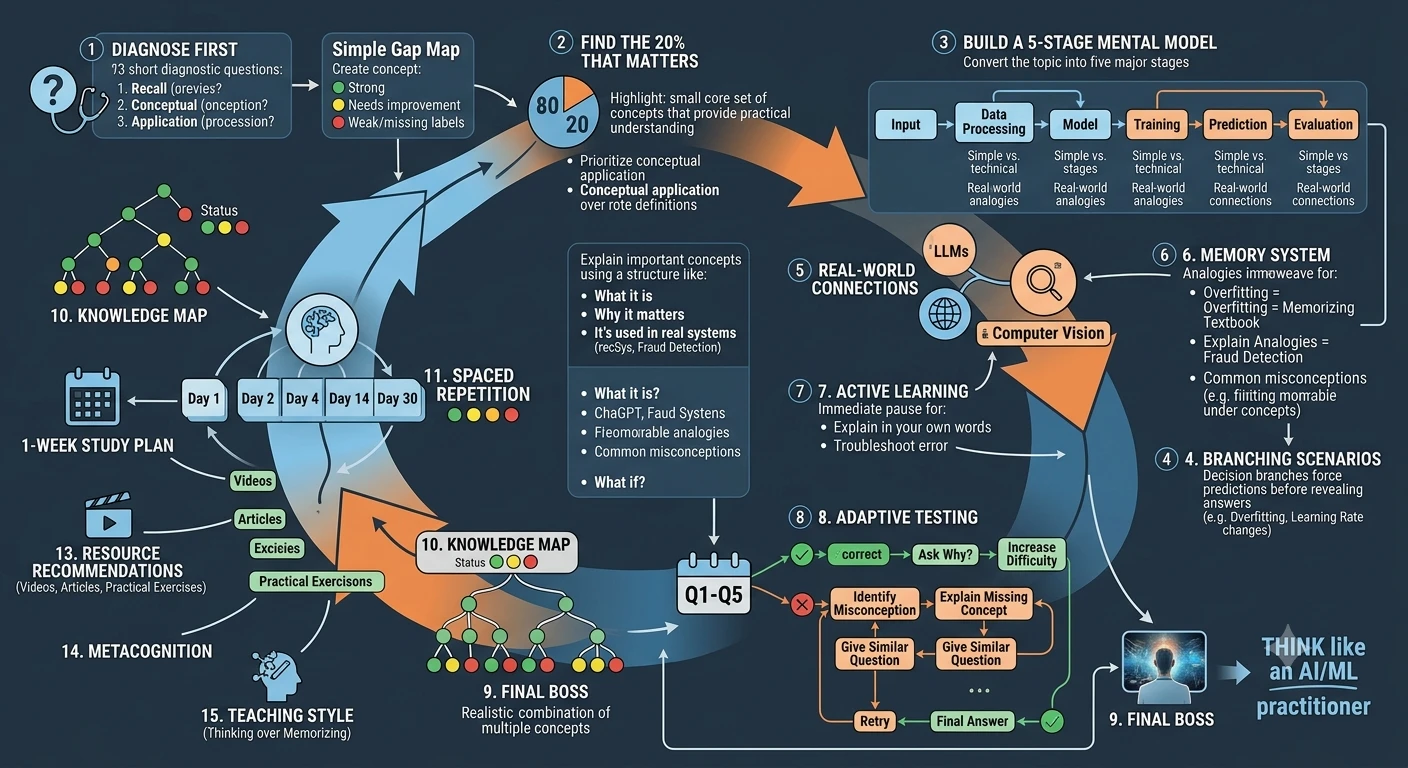
The Adaptive AI/ML Master Prompt converts any high-capability LLM into a world-class, adaptive learning coach that diagnoses your current knowledge gaps, builds 5-stage mental models, runs branching "what-if" simulations, and tests your reasoning step-by-step.
Why Standard Prompts Fail (And Why This Framework Works)
When you ask standard questions, LLMs default to explanation mode—they talk at you. This framework forces the AI into tutor mode by embedding 15 pedagogical constraints:
- Diagnostic Gap Mapping: Before teaching, the AI asks three targeted questions (recall, conceptual, and application) to assess what you actually understand versus what technical jargon you are parroting.
- The 80/20 Pareto Rule: Instead of overwhelming you with syntax or edge cases, it focuses purely on the small set of foundational concepts that unlock practical understanding.
- 5-Stage Mental Models: Every concept is broken down from simple to technical, paired with flowcharts, real-world analogies, and connections to production systems like ChatGPT, recommendation engines, or fraud detection models.
- Branching "What-If?" Scenarios: You are forced to predict failure modes—like model overfitting, data imbalance, or learning rate spikes—before the AI reveals the technical answer.
- Adaptive Testing: Questions automatically adjust to your level using Bloom's Taxonomy, progressing from basic recall up to a final system design challenge.
The Master Prompt
Copy and paste the master prompt into ChatGPT, Claude, or Gemini. Simply replace [TOPIC] (e.g., Gradient Descent, Transformer Architectures, Random Forests, Neural Network Fine-Tuning) with the exact topic you want to master.
- AI/ML Learning Tutor — Master PromptCopy the full 15-stage adaptive master prompt template.
How to Get the Most Out of This Session
- Pick a Specific Target: Instead of generic topics like "Artificial Intelligence", narrow it down to precise mechanisms: Backpropagation, Convolutional Neural Networks, Retrieval-Augmented Generation (RAG), or Precision vs Recall.
- Answer Without Cheating: When the AI asks you the 3 diagnostic questions, answer naturally with your current understanding. If you do not know, say "I don't know." This allows the Gap Map engine to correctly calibrate the learning path.
- Engage with the "What-Ifs": When the AI hits a branching decision point, force yourself to write out your prediction. Getting a prediction wrong is the fastest way to rewire a technical mental model.
- Save Your Session: Keep your review schedule and 7-day study plan generated at the end of the prompt for spaced repetition over the coming month.
Plug in your first topic, answer the diagnostic questions, and test how much deeper your technical intuition becomes in a single 20-minute session.
FAQ
Which LLM works best with this Master Prompt?
Claude 3.5 Sonnet, GPT-4o, and Gemini 1.5 Pro excel at following all 15 pedagogical rules and managing state across long interactive sessions.
Can I use this for non-AI/ML technical subjects?
Yes! You can replace [TOPIC] with any complex technical domain like Distributed Systems, Quantum Computing, Database Indexing, or Organic Chemistry.
Do I need coding experience to use this tutor prompt?
No. The prompt explicitly instructs the tutor to use plain language first and intuitive analogies before code, introducing code only when necessary.